
Evidence-based comparison
Agency Pilot vs HubSpot
Compare the specific HubSpot products and configuration you need with Agency Pilot’s client delivery workflow. A broad product family should not be treated as one fixed plan, one price or one data model.
HubSpot’s official materials distinguish Marketing Hub and its wider CRM product family. Its support documentation describes marketing-email automation and workflows, with availability dependent on subscription. This page does not assume that custom objects, portals or other capabilities are available on every edition, and it does not infer that a configured HubSpot system cannot support agency work.
The evaluation should follow a won engagement moving from the sales record into access collection, assigned work and a first client review. Write down the starting information, the person responsible and the result that would count as successful. Use that same scenario in each option. A product label such as reporting, automation or access is not enough to establish that two configurations perform the same action or require the same manual work.
Start with the current sales record and list the information that must survive a handoff: contact identity, company, opportunity context, agreed scope and next owner. Decide whether the delivery team needs the complete sales history or a reviewed summary with links back to it. Keep marketing automation and pipeline reporting requirements explicit when comparing configurations. A client workspace may improve operational continuity without replacing every specialised sales process; the evaluation should show which responsibilities stay in each system.
Side by side
The differences that actually decide it
| Agency Pilot | HubSpot | |
|---|---|---|
| Scope of comparison | Client operations and supported marketing-data workflows | Identify the HubSpot products, editions and configuration being evaluated |
| Automation | Evaluate supported triggers, conditions and actions | Vendor documents marketing automation and subscription-dependent workflows |
| Client structure | Client-linked projects, tasks and reports | Test the intended business/contact model in the actual configuration |
Evidence reviewed 14 October 2026: Agency Pilot capabilities were checked against product code; HubSpot capabilities are vendor-documented. This is not a hands-on competitor test. Verify current plan entitlements with the linked sources. An unverified requirement is not treated as an absent feature.
Reasons to retain or choose HubSpot
- Your team has a dependable HubSpot configuration or a specific documented marketing requirement whose replacement has not been demonstrated.
- A representative evaluation meets the required outcome with acceptable manual work, and the people responsible can maintain the configuration.
- The transition would put a critical existing workflow or historical context at risk without a demonstrated operational benefit.
Reasons to evaluate Agency Pilot
- You want to evaluate delivery organised around client businesses, account access, projects, research and reports.
- A complete client example confirms the supported connections and delivery steps you need, including the ordinary exception that usually causes a handoff problem.
- The proposed process makes ownership and the next action clearer while retaining specialist tools whenever they still perform an essential job.
A concrete evaluation to run
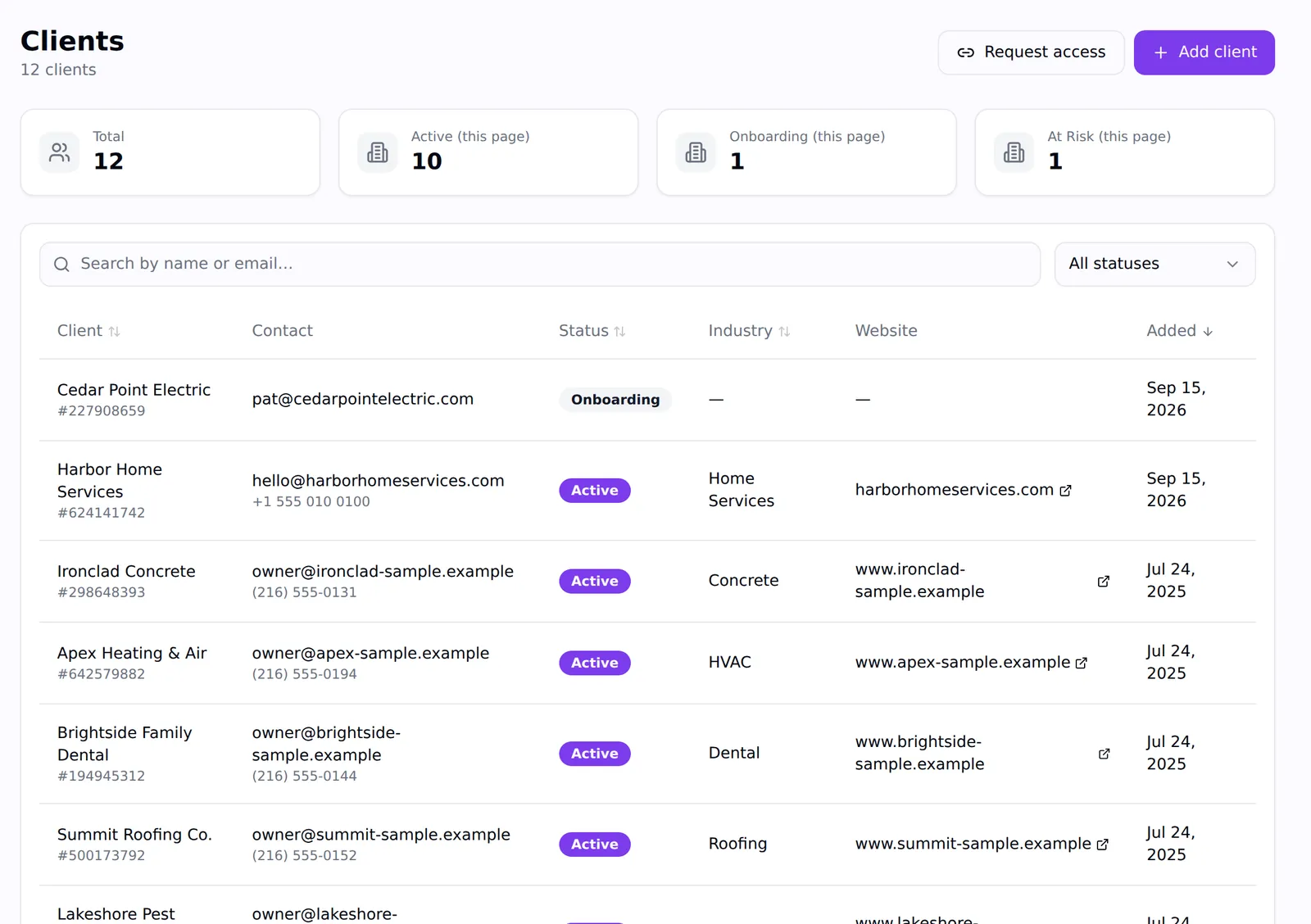
An illustrative agency has three sales users, twelve delivery clients and two new wins this month. Its question is whether the handover from a won opportunity to the first client deliverable can be made clear without losing important sales context.
- Choose one won engagement and identify the agreed scope, contacts, required assets and outstanding promises. Specify which HubSpot products and edition are in the evaluation.
- Move the necessary information through the verified handoff method, manually if needed. Check that client businesses and their contacts are represented correctly.
- Complete access collection and an initial assigned task. Ask a delivery colleague to explain the next decision without consulting the original salesperson.
Pass condition: The handoff preserves the agreement and contact context, creates clear delivery ownership and leaves an explicit route back to the historical sales record.
Workload and cost worksheet
Planning example only: the workload below is illustrative, not a customer result or a tested benchmark. Replace it with your actual service. Obtain current quotes for the same currency, billing term and required entitlements; no competitor subscription price is assumed.
| Input | Calculation or evidence to collect |
|---|---|
| Scope | 3 sales users, 12 delivery clients and 2 monthly wins. Record marketing-contact and other billing definitions for the exact HubSpot configuration. |
| Product quote | Include the specific hubs, edition, seats and required implementation services. Avoid using an entry price for a different configuration. |
| Delivery option | Quote Agency Pilot for the relevant client capacity and research usage. If HubSpot stays for sales or marketing, keep that cost in both scenarios. |
| Handoff cost | Measure minutes per won engagement for data preparation, verification and correction. Multiply by the expected monthly wins and your loaded hourly rate. |
Calculate each option separately: recurring software + metered usage + retained tools + measured monthly labour. Show one-time migration costs separately; if spreading them across a planning horizon, state that horizon. Subtract only subscriptions you can genuinely retire. An unfinished quote or untested workflow is an unresolved input, not a zero-cost item.
Migration steps and limits
- Inventory the fields, attachments and history needed by active delivery accounts. Record which system remains authoritative for sales information.
- Validate a sample handoff, including several contacts at one business and a missing approval. Do not assume custom fields or history transfer automatically.
- Expand by client group after the first deliverable succeeds. Keep the old records accessible under your retention process until the new team workflow is reliable.
HubSpot is a product family; this evaluation does not claim all editions have the same capabilities or cost. No native integration, complete migration or automatic object mapping is assumed.
Sources
- HubSpot Marketing Hub overview
- HubSpot automation scope and subscription requirements
- HubSpot marketing-email automation
- Agency Pilot client workflow and feature scope
Think something here is out of date or unfair? Tell us and we will correct it.
Put your agency on autopilot
Start a 14-day trial with 300 credits. Add your first client and send an onboarding link today.
Set the scope of an Agency Pilot vs HubSpot comparison
An Agency Pilot vs HubSpot comparison needs a precise product scope. HubSpot is a product family, and this page distinguishes the documented Marketing Hub and automation capabilities from a configuration you would actually purchase. Keep that distinction in your purchasing notes. A requirement may depend on another product, edition or configuration. Name the complete combination you intend to evaluate and verify the current offer that would serve your agency.
Start with two separate questions: how will your agency win its own customers, and how will it manage work for client businesses? Those activities can share contacts, but their operating needs differ. An agency's sales pipeline is not the same as a client's recurring delivery plan. Map the relationships you need before evaluating fields and dashboards. This helps you identify when a familiar CRM fits naturally and when a delivery workflow needs additional structure.
Model a real client relationship before building reports
Choose a representative engagement that includes a business, several contacts, an ongoing service and a location if relevant. Explain who belongs to which organisation and what each person should be able to see. Then trace a routine task such as preparing a monthly review. Ask where the agreement, account access, completed work and report are stored. The exercise reveals whether the proposed setup preserves context or requires the account manager to reconcile several records manually.
Agency Pilot organises its delivery workflow around client businesses. When evaluating another CRM configuration, test how your intended model would be represented and maintained. Do not assume that a possible customisation is available on every edition or that the time to configure it is negligible. Equally, do not discount the value of an existing setup that your team understands and has already made reliable. Compare the actual workflows available to your agency.
Separate adoption cost from subscription cost
A pricing comparison should include the relevant plan, seats, contact definitions, required products, implementation services and any ongoing administration. Read the current commercial terms for the offer you are considering. The worksheet makes the inputs visible, but your own configuration determines the purchase. Avoid comparing a minimal entry plan in one product with a fully configured system in another unless the difference is explicitly explained.
Include the cost of organisational change. A team already fluent in its CRM may work effectively with an established process that looks complicated to an outsider. A new platform requires record cleanup, decisions about ownership and training for ordinary exceptions. Measure a representative task before and after rather than assuming a shorter feature list means zero setup. The goal is a system the team can maintain, not merely one that appears inexpensive on the day it is purchased.
Evaluate reporting from the reader back to the data
Start with the question the client needs answered. For a local SEO engagement, that might concern visibility in a service area and the work planned next. For the agency's own sales activity, it might concern opportunities and follow-up. Keep those reports distinct so each is built from the right records. A dashboard can contain many accurate values and still fail to answer the decision its reader needs to make.
Test the data path behind a report. Identify the source, period, owner and any manual input. If the report includes recorded sales, check who supplies those outcomes and how missing updates are described. If it includes ranking data, preserve the scan configuration. Evaluate whether a colleague can explain the output using the record alone. This is a stronger reporting test than whether a chart can be made to resemble a familiar slide.
Plan a staged transition or a deliberate division of work
You may decide to keep one system for agency sales and use another for client delivery. In that case, define the moment a won opportunity becomes a delivery engagement and the information that must accompany it. Do not assume a native integration between products or a complete automatic transfer unless you have verified it. A documented manual handoff can be workable at some volumes, but it must have an owner and a clear finish condition.
An illustrative pilot could follow one recently signed client. The sales owner provides the agreed scope and contacts; the delivery owner verifies account access, starts the project and prepares the first client update. Record any missing information that forces the team back into old messages. Fix the handoff before moving more accounts. Keep the earlier system available for the historical context needed during the transition.
Conclude with a decision that states the product and edition evaluated, the workflow confirmed and the services that remain outside it. If a current system continues to serve an essential role, include that openly. A useful comparison can support keeping an established CRM, changing the delivery layer or postponing a move until a requirement is resolved. The outcome should follow the evidence from your agency's work, not a universal claim that one category is always superior.
Frequently asked questions
Does this page compare every HubSpot product?
No. It discusses documented marketing and automation capabilities while asking you to define the products and editions relevant to your workflow. HubSpot’s broader product family is not one fixed feature bundle. For a purchasing decision, specify the configuration you would use and verify its current terms and behaviour. That makes the comparison meaningful for your actual agency.
What is the difference between agency sales and client delivery?
Agency sales concerns winning work for your own business. Client delivery concerns carrying out the agreed work for another business, including its contacts, assets, tasks and reports. The activities connect, but they need different context. Map both before deciding whether one system should manage them or whether a deliberate handoff is more appropriate.
Should I replace a CRM my team already understands?
Only when a defined improvement justifies the disruption and ongoing tradeoffs. Staff familiarity, existing records and reliable habits have value. Test the specific problem you want to solve and include migration and retraining effort. A new interface alone is not evidence that the team will deliver work more accurately or communicate with clients more effectively.
How should I test the client data model?
Create a representative business with the contacts, locations and services you regularly manage. Trace an ordinary task through the records and check whether another teammate can find the context. Include permissions and client-facing information in the test. A simple demo contact may conceal the complexity that appears when several people and business assets belong to one engagement.
Can a custom configuration satisfy our requirements?
Possibly, but confirm the required edition, setup effort and maintenance responsibility before treating it as available. Write down the objects, fields, workflows and permissions involved. Ask who will support the configuration when your process changes. A feasible customisation can be a good solution; an untested assumption about customisation should not be counted as a completed capability.
How do we compare contact-based and client-based pricing?
Translate your workload into each product’s actual billing definitions. Marketing contacts, users, client businesses and usage credits are different units. Check the current rules for the plan you would purchase and model the next realistic stage of growth. Do not compare equal numerical allowances without confirming what each allowance represents and which activities count toward it.
What should an implementation estimate include?
Include record cleanup, configuration, training, report validation and the time to handle exceptions during the first delivery cycle. Add any required external service or commercial onboarding charge from the selected offer. Keep one-time effort distinct from recurring cost. This gives the agency a more useful decision basis than a subscription comparison that assumes the operating system appears fully configured.
Can we retain one system for sales and another for delivery?
Yes, if the responsibilities and handoff are clear. Define which record is authoritative, what information must transfer and who verifies it. Check any integration explicitly instead of assuming full synchronisation. Test a recently won engagement through its first deliverable. A divided setup should make ownership clearer, not leave both teams expecting the other system to contain the missing details.
How should we compare client-facing access?
Test the exact experience required: what the client sees, which records are available and how you control visibility. Product names such as portal can cover different workflows and editions. Use realistic client content and verify the selected configuration. Also test who maintains the information, because a client-facing screen is useful only when its content stays accurate and understandable.
Does a general CRM replace local rank measurement?
Not automatically. List the research outputs your service needs and check which tool supplies them. Agency Pilot includes local research workflows described on its feature pages. If another setup relies on a specialist service, include that service in the evaluation. The decision should compare complete delivery processes rather than assume every CRM produces every required measurement.
What should happen to historical sales and delivery records?
Identify what must remain accessible for active engagements and preserve older context through the available export or retention process. Do not assume that every field, attachment or historical event will migrate automatically. Validate a small sample before expanding the move. Explain where the team should look during the transition so client questions do not become a search across undocumented archives.
How can we test reporting quality?
Choose a real question, identify the underlying data and ask a teammate to explain the resulting report. Check the period, definitions and missing inputs. A visually impressive dashboard can still combine unlike measures or omit important context. Judge the report by whether it supports an accurate decision and whether its explanation can be repeated by someone other than its creator.
Should the cheapest entry plan decide the purchase?
Only if that plan meets the actual requirements and expected workload. Confirm the relevant limits, products and commitments, then include retained tools and implementation effort. An entry price can be attractive without representing the configuration you need. Equally, a more expensive package is not justified by functions the agency will not use.
What evidence should we collect during a trial?
Record the business scenario, product edition, steps completed, manual work and unresolved limitations. Include a client-facing example if that is part of the requirement. Ask ordinary team members to repeat the workflow. The resulting evidence should show whether the process works beyond a prepared demonstration and what your agency would need to maintain after purchase.
Why are there no fixed HubSpot prices in this comparison?
The relevant cost depends on the specific products, edition, seats and other billing definitions your configuration requires. Use the current quote for that configuration and include implementation and retained tools. The worksheet provides assumptions to fill in rather than a stale entry price. Compare the complete sales-to-delivery process you intend to operate.