
Evidence-based comparison
Agency Pilot vs Local Falcon
Compare the local research you need and the workflow around it. Local Falcon now describes a wider local SEO platform, so this evaluation considers documented automation and reporting as well as the geographic measurement itself.
Local Falcon currently documents geographic rank tracking, AI visibility, Falcon Agent workflows, Business Profile monitoring and scheduled reporting. Its feature page also lists integrations and API access. Review the current plan requirements for the monitoring and automation tasks your agency needs.
The evaluation should follow a local service business establishing a repeatable visibility baseline and turning one finding into an assigned action. Write down the starting information, the person responsible and the result that would count as successful. Use that same scenario in each option. A product label such as reporting, automation or access is not enough to establish that two configurations perform the same action or require the same manual work.
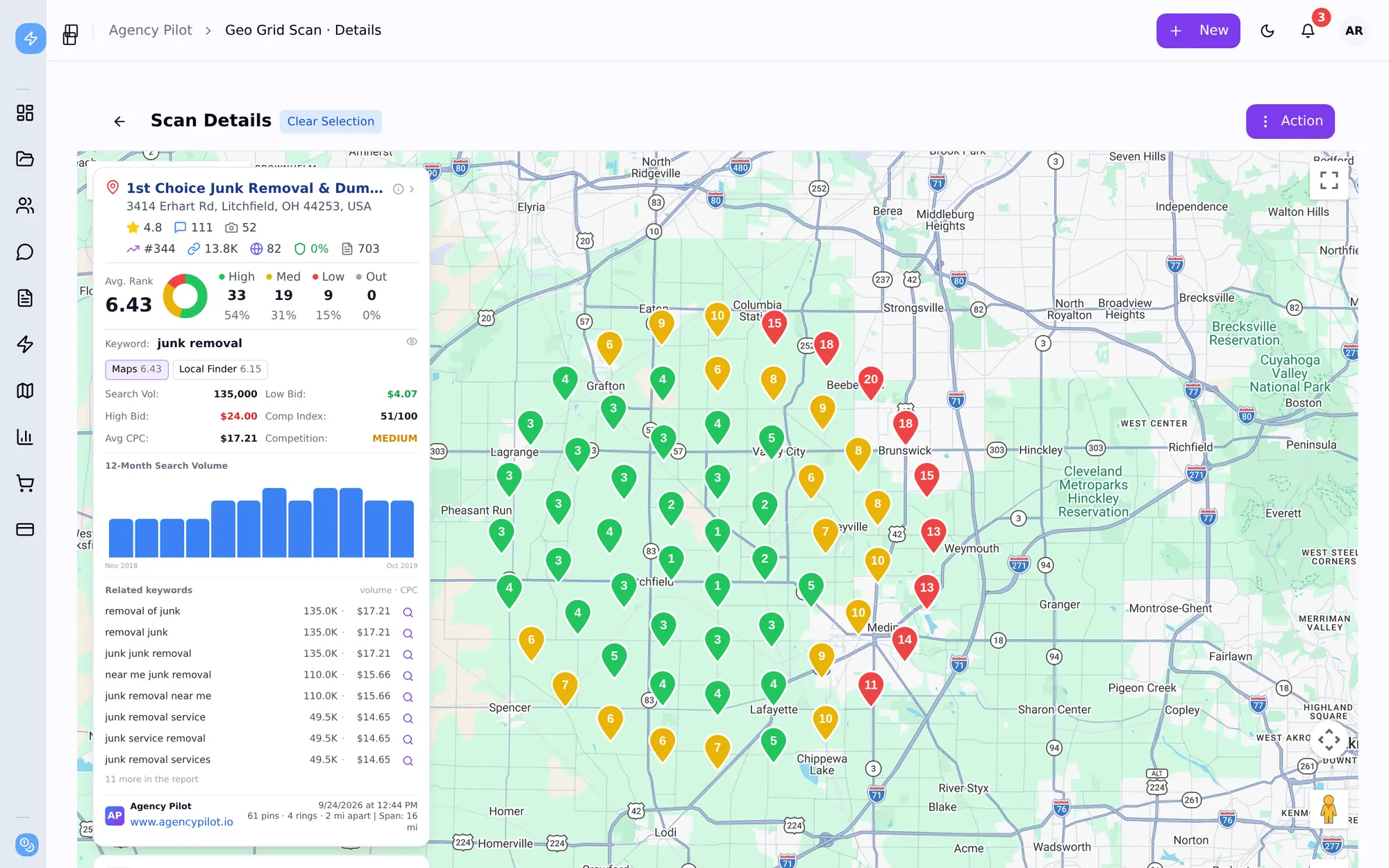
For a local visibility investigation, hold the business identity, keyword, grid coordinates and observation window as steady as possible. Record each tool’s result surface and treatment of positions outside the tracked depth. Similar map colours can represent different thresholds, so compare definitions before treating them as equivalent. Then follow one finding into the next action: who checks the listing, where the decision is recorded and how the client receives the explanation. That handoff may matter as much as the scan itself.
Side by side
The differences that actually decide it
| Agency Pilot | Local Falcon | |
|---|---|---|
| Local measurement | Maps, Local Finder and organic geo-grid workflows | Vendor documents geographic rank tracking; verify the selected search configuration |
| Work after research | Client-linked projects and assigned tasks | Vendor documents Falcon Agent local SEO workflows |
| Ongoing monitoring | Evaluate scan history and client reporting | Vendor documents Business Profile monitoring and scheduled reports |
Evidence reviewed 14 October 2026: Agency Pilot capabilities were checked against product code; Local Falcon capabilities are vendor-documented. This is not a hands-on competitor test. Verify current plan entitlements with the linked sources. An unverified requirement is not treated as an absent feature.
Reasons to retain or choose Local Falcon
- You rely on a documented Local Falcon measurement, monitoring or automation workflow that you have not confirmed in a replacement.
- A representative evaluation meets the required outcome with acceptable manual work, and the people responsible can maintain the configuration.
- The transition would put a critical existing workflow or historical context at risk without a demonstrated operational benefit.
Reasons to evaluate Agency Pilot
- You want to connect geographic research with client access, project tasks and the wider agency relationship.
- A complete client example confirms the supported connections and delivery steps you need, including the ordinary exception that usually causes a handoff problem.
- The proposed process makes ownership and the next action clearer while retaining specialist tools whenever they still perform an essential job.
A concrete evaluation to run
An illustrative local SEO team tracks ten single-location businesses, three keywords per location and two measurement dates per month. It needs a comparable visibility trend and a reviewed action for one weak area, not a guaranteed ranking improvement.
- Select one business and keyword, document the geographic points and search surface, then run comparable configurations. Record differences that prevent a direct comparison.
- Inspect a missing result and a competitor result at individual points before comparing summary metrics. Record how each calculation handles not-found points.
- Take one finding through an assigned action and the next client explanation. If a vendor automation is part of the requirement, verify that particular action and its approval behaviour separately.
Pass condition: The analyst can explain the measurement and its limitations, reproduce the intended configuration, and show who owns the action proposed from the result.
Workload and cost worksheet
Planning example only: the workload below is illustrative, not a customer result or a tested benchmark. Replace it with your actual service. Obtain current quotes for the same currency, billing term and required entitlements; no competitor subscription price is assumed.
| Input | Calculation or evidence to collect |
|---|---|
| Measurement volume | 10 locations × 3 keywords × 2 dates = 60 scans per month before retries or investigations. Multiple search surfaces are separate work, not free equivalents. |
| Configuration | Choose a documented point count, geometry and search depth. Obtain the current cost for that actual operation in each product; provider credits are not interchangeable. |
| Additional outputs | List reports, AI observations and profile-management work separately. Check what is included and what consumes additional allowance or requires a different offer. |
| Operating effort | Time scan review, explanation and exception handling. Use the observed hours and your own labour cost rather than assuming one tool saves a fixed amount. |
Calculate each option separately: recurring software + metered usage + retained tools + measured monthly labour. Show one-time migration costs separately; if spreading them across a planning horizon, state that horizon. Subtract only subscriptions you can genuinely retire. An unfinished quote or untested workflow is an unresolved input, not a zero-cost item.
Migration steps and limits
- Export relevant historical scans with their dates and settings before changing the reporting process. Preserve the definition of the old summary metrics.
- Run an overlap example and explain any methodological difference. Begin a labelled new baseline when the measurements cannot be made equivalent.
- Check scheduled research, reports and any management automation before ending the previous service, so a necessary recurring action is not silently stopped.
The trial does not establish a universal accuracy winner. No historical-scan import, identical metric definition or like-for-like automation replacement is promised.
Sources
- Local Falcon current feature catalogue
- Local Falcon integration information
- Agency Pilot client workflow and feature scope
Think something here is out of date or unfair? Tell us and we will correct it.
Put your agency on autopilot
Start a 14-day trial with 300 credits. Add your first client and send an onboarding link today.
Make the Agency Pilot vs Local Falcon scan comparison fair
An Agency Pilot vs Local Falcon evaluation should begin with a controlled measurement example. Choose one business identity, one keyword and a defined area. Record the centre, point locations, result type, depth and timing. Similar-looking maps are not necessarily equivalent measurements. A difference in coverage or the treatment of a business that was not found can change the summary even when the underlying rankings are similar.
Read the definitions attached to each metric instead of assuming that familiar terms are identical. A top-three percentage and an average ranking answer different questions. The product comparison above distinguishes reviewed code from vendor documentation, while your pilot should confirm the settings relevant to your service. Preserve the raw scan context so you can explain a discrepancy rather than selecting whichever summary looks most favourable to your agency.
Assess the reporting job around the grid
Decide who consumes the output. An analyst may need to inspect point-level results and investigate a competitor; a client owner may need a clear explanation of changes in the area that brings suitable enquiries. Those are different reporting jobs. Test both with the same scan. Ask whether the analyst can support the conclusion and whether the client can identify the next decision without learning the entire interface.
Agency Pilot puts local research beside client records, onboarding and delivery workflows. That is relevant when the agency repeatedly transfers context between systems. It may be less important when your existing operations stack is already effective and you want a specialist measurement tool. Record the tools you would keep in either case. Consolidation should be evaluated through a real monthly review, not presumed from a list of functions that your team may never use.
Price the measurement plan you intend to deliver
Create a usage scenario from your actual clients, locations, keywords and reporting cadence. Include diagnostic scans and any additional research or analysis you expect to use. Check the cost of the selected configuration rather than multiplying a headline credit price across unlike operations. A credit is a provider-specific unit; the same number of credits does not necessarily represent the same work in two products.
Include the subscription commitment, unused capacity and the cost of retained tools. The lowest raw scan cost can be the correct choice for a measurement-heavy agency, while an agency spending substantial effort coordinating delivery may value a connected workflow. Keep those arguments separate and quantify them where you have evidence. Do not attribute a financial saving to a subscription you cannot actually retire or to staff time you have not observed.
Preserve continuity when changing rank trackers
Before switching, export the information you need from the existing tool and retain its settings and dates. Do not assume that historical scans can be imported or that old and new averages belong in a seamless trend line. Run a documented overlap example to understand differences. Explain to clients when a new baseline starts and why an apparent numerical change may reflect measurement configuration rather than a sudden change in visibility.
An illustrative pilot might follow one service business through an initial scan, a planned delivery task and a later repeat scan. The analyst records what changed, the account manager prepares the explanation and the client reviews the result. Use that complete cycle to judge fit. A colourful first map is easy to demonstrate; a repeatable, understandable reporting process is the more important test for an agency that must deliver it every month.
Frequently asked questions
What should I compare before looking at price?
Confirm the search surface, geographic coverage, depth and reporting output you need. A low-cost scan is useful only if it answers your measurement question. Write down any specialist requirement that would decide the purchase and verify it using current product documentation. Then compare costs for equivalent work, including the other tools required by your delivery process.
Why can two grid tools show different averages?
They may use different points, search times, depths or rules for businesses that are not found. Even a matching keyword does not make the measurement identical. Inspect the definitions and point-level context before deciding which figure to report. Preserve the settings with the result so the difference can be explained to colleagues and clients.
Is top-three coverage the same as market share?
No. It describes the proportion of measured points where the target appears within the defined top positions. It does not directly measure customer numbers, impressions or revenue across the market. Use the figure to discuss geographic visibility under the scan configuration. Avoid presenting an unweighted grid percentage as the business’s share of all available demand.
Should I use identical grid shapes in a trial?
Use comparable locations where possible and document any difference in shape or point placement. A circle and a square can cover different areas even with similar point counts. If your service specifically needs one shape, test that requirement explicitly. Do not call a configuration mismatch a ranking discrepancy without inspecting what each scan actually sampled.
How do I compare credit systems?
Translate the intended operation into its displayed cost in each product, then model the monthly workload. Provider credits are not a shared currency. Include the relevant scan type, point count and additional outputs. Read the current rules for allowances and unused usage. This is more reliable than comparing two credit totals without knowing what those credits buy.
What should a client-facing grid report explain?
Identify the business, keyword, area, scan date and the meaning of the summary. Explain a material change and the action you recommend next. Keep revenue estimates separate from observed rankings. The report should help the owner understand a business question, while retaining enough measurement detail for the agency to verify the conclusion behind it.
Can I compare old Local Falcon history with a new baseline?
You can retain and discuss the earlier evidence, but keep its original settings and provenance visible. Do not assume automatic import or identical metric definitions. An overlap period can help identify systematic differences. Explain the transition clearly so clients do not interpret a change in tool or configuration as proof that their rankings suddenly improved or declined.
How often should I scan during an evaluation?
Run enough repeat measurements to test your intended reporting routine and investigate material discrepancies. A single snapshot cannot establish a long-term trend. Avoid treating every small movement as meaningful. Choose a cadence suited to the decisions your agency makes and consider the usage cost, rather than scanning frequently only because a trial allowance is available.
Does a deeper search always improve the report?
Greater depth can help investigate a business outside the leading results, but it does not automatically improve every client explanation. Decide what question the additional depth answers and how missing results are represented. Keep that configuration consistent for comparisons. More detail is valuable when it informs an action, not merely when it makes a table longer.
When might a specialist rank tracker fit better?
It may fit when local measurement is the main requirement and the agency already has dependable systems for onboarding, client communication and delivery. Test the specialist capabilities you rely on and the output your analysts use. A broader platform should not be chosen solely because it contains more functions than the narrowly defined job requires.
When does a connected agency workflow matter?
It matters when the research must repeatedly be joined to client context, tasks, reports and discussions. Follow a scan through your monthly delivery process and identify manual handoffs. If those handoffs create errors or missing context, evaluate the connected workflow directly. Keep the specialist tools that remain necessary in the comparison instead of assuming every dependency disappears.
Should trial results be shown to clients immediately?
Review the configuration and interpretation first. A preliminary map can be useful, but label it as an evaluation result if you are still checking settings or definitions. Avoid sending an unexplained comparison that appears to contradict an established report. The agency should understand what the new measurement says before asking the client to make a decision from it.
How do I assess multi-location reporting?
Choose more than one representative location and confirm that each result stays associated with the correct business identity. Check how your team would review location-level detail and communicate a portfolio summary. Do not simply average unlike grids. Different coverage areas and commercial importance may require an explanation that a single combined percentage cannot provide.
What should be in the purchasing decision note?
Record the measured workflow, current plan considered, necessary integrations, expected monthly usage and unresolved limitations. Include the strongest reason to retain the current system. Keep screenshots or exported examples with their dates where appropriate. A decision note makes the choice reviewable later when the agency grows or a previously optional requirement becomes essential.
Does the worksheet establish which tool is cheaper?
No. It specifies a workload so you can compare current quotes for the actual scan configuration, additional outputs and retained tools. It does not publish a universal per-scan price or assume equivalent credits. Use the same measurement requirements and your observed review effort before drawing a cost conclusion for your agency.