Skip to content
Agency Pilot

Local SEO

Keyword rank tracking

Set up a tracking project for each client, add the keywords that matter for their market, and Agency Pilot checks them weekly or monthly for the location you choose — in the same record as their geo grids, audits and leads.

Projects per client

Each client gets tracking projects with their domain, keywords and target location.

Weekly or monthly

Checks run on the schedule you set; history builds automatically.

Keyword history

Position over time for every keyword, per project.

Keyword research built in

Volume, cost per click, difficulty, intent and whether AI assistants mention the topic.

Priced per check

Credits per keyword per check, shown before tracking starts — no per-seat licence.

Rolled into reports

The Monthly Client SEO Report and Progress Report include tracked rankings.

Organic rankings, where the client competes

Geo grids answer "where on the map do we show up". Keyword tracking answers the other half: where the client's site ranks in regular Google results for the terms that bring in work, checked for the market they serve.

Choose the client, the domain, the location and the keywords, set weekly or monthly, and each check records the position. Because tracking lives in the client record, you see rankings next to leads and revenue, not in a separate tool.

Find the keywords worth tracking

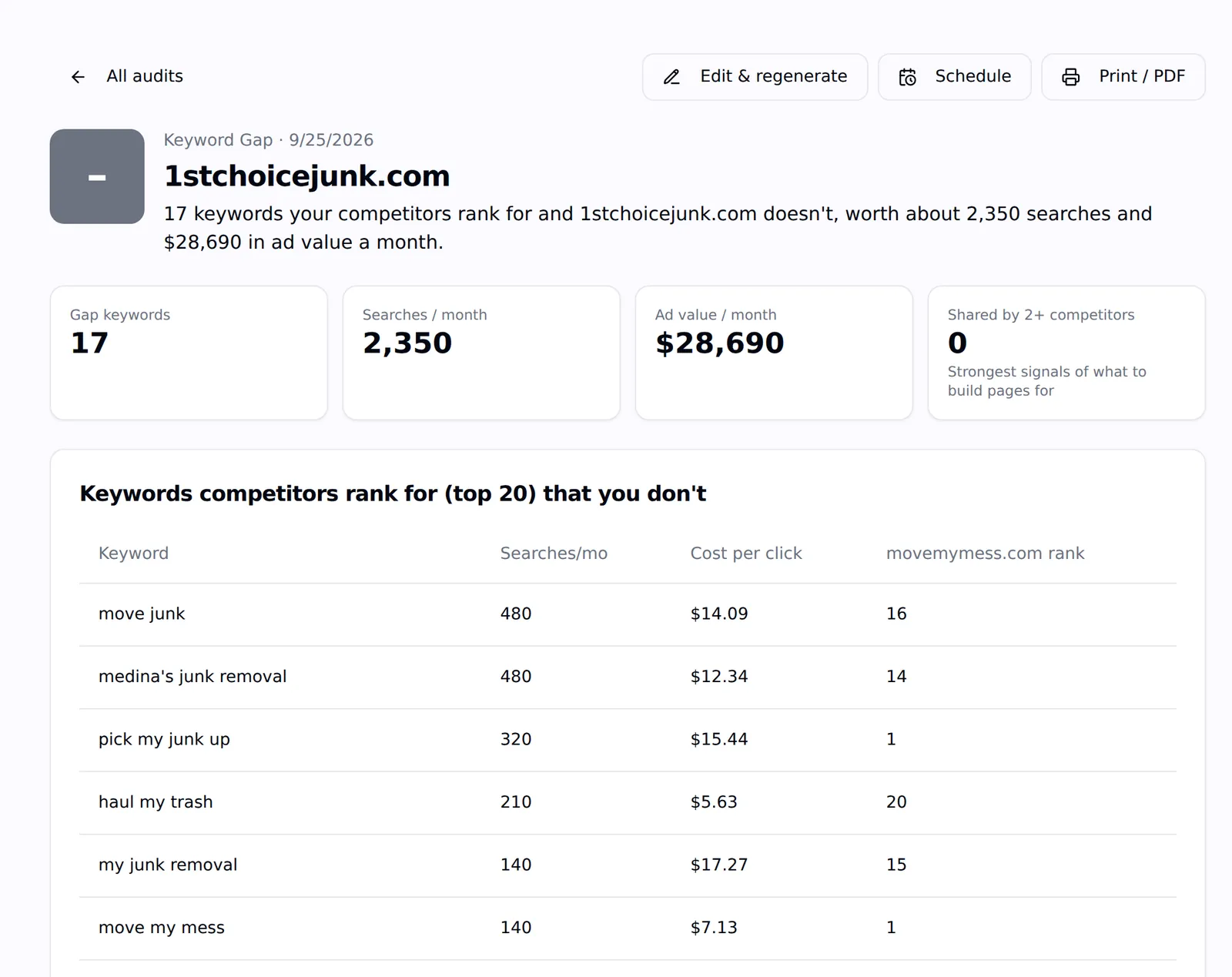
Keyword research returns search volume, cost per click, difficulty, intent and whether AI assistants such as ChatGPT and Gemini mention the topic. The Keyword Gap audit finds terms competitors rank for that the client doesn't, and the Market Opportunity audit shows monthly volume and seasonality for each service in each city.

A Keyword Gap audit listing keywords competitors rank for, with searches per month and cost per click
Keyword Gap: what competitors rank for that the client doesn't.

What this does not do

Better to find this out here than three weeks in.

  • It tracks Google. Bing and other engines aren't tracked.
  • Checks run on schedule, not daily.
  • Keyword research history is kept for 30 days and isn't tied to a client; save the keywords you want into a tracking project.

Questions

What's the difference between rank tracking and a geo grid?
Rank tracking checks where a site ranks in regular results for a location. A geo grid checks local results from many points across a map. Local SEO needs both.
Can I track rankings in a specific city?
Yes. Each project has a target location, so checks reflect the market the client serves.
Can clients see their rankings?
Rankings roll into the Monthly Client SEO Report and Progress Report, which you can share or show in the client's portal.

Put your agency on autopilot

Start a 14-day trial with 300 credits. Add your first client and send an onboarding link today.

Start keyword rank tracking with a business question

Keyword rank tracking works best when the agency can explain why each term belongs in the project. Begin with the services the client wants to sell, the locations they serve and the pages intended to answer those searches. A long keyword list is not automatically a useful measurement plan. A smaller set with a clear purpose can make changes easier to interpret and reporting easier for an owner to follow.

Agency Pilot keeps tracking projects with the client record, including the domain, target location and scheduled keyword checks. Use that context to connect a ranking observation with the client's current work. Before the first check, confirm the correct domain and location. Then agree which results would lead to an action, such as reviewing a service page or investigating a keyword gap. This turns the tracker into a practical part of the delivery process.

Separate service, brand and research intent

Different searches represent different stages of a customer's decision. A brand query usually comes from someone who already knows the business. A service query may indicate that a person is comparing providers. An informational question may belong to a resource page that helps someone understand a problem before they contact anyone. Keep those purposes distinct when selecting keywords and explaining the results.

For example, a hypothetical roofing business might care about its own name, a local repair service and a question about roof maintenance. All three can be relevant, but a strong result for the business name does not demonstrate improved discovery for repair work. Use keyword research to add context about demand and intent, then review the list with the client. The final tracking set should reflect work the business actually performs and information it can genuinely provide.

Map tracked terms to useful website content

For each important keyword, identify the page that should satisfy the searcher's need. The exercise often reveals a practical content problem before any ranking check: the website may not clearly describe a service, may send several different needs to one vague page or may have several pages competing to answer the same question. Record the intended page in your working plan and inspect whether its content matches the customer's task.

This is an editorial review your agency performs around the tracking project; do not assume that adding a keyword changes the website. A tracked term simply gives you a recurring observation. If the page needs work, define that work separately, including the information the client must supply and the person who will approve it. The next ranking review can then reference an actual content change rather than treating measurement itself as optimization.

Keep the target market consistent across checks

A local business needs a measurement that reflects its market. Agency Pilot's projects include a target location, so verify that choice before relying on the results. If the business serves more than one market, decide which question each project answers rather than silently replacing the location in an established series. A new market can deserve a new baseline while the original project continues to show the existing territory.

Keep the keyword list stable enough to compare periods. Adding terms is useful when the business introduces a service or discovers an opportunity, but new terms do not have the same history as established ones. Explain additions and removals in the reporting notes. A transparent measurement plan lets the client distinguish a change in the business's visibility from a change in the set of searches the agency chose to monitor.

Choose a reporting cadence that supports decisions

Agency Pilot checks tracked keywords on a weekly or monthly schedule. Choose the cadence around the engagement and what the team can realistically investigate. Weekly observations can support active work, while a monthly view can fit a broader client review. Neither schedule makes every movement significant, and a single change should not automatically trigger a rewrite of the strategy.

Decide in advance how the team will handle an apparent decline. First verify the project settings and compare the affected terms. Then review relevant website changes and the search context before deciding on a fix. This sequence helps prevent reactive edits based on an isolated position. The value of a recurring schedule is the history it builds, allowing your agency to discuss patterns and uncertainty rather than present every check as a final verdict on the quality of the work.

Connect rankings with enquiries without confusing them

A higher ranking can be a useful visibility signal, but it is not a sale. Search demand, the result presentation, the landing page and the business's follow-up all influence what happens next. Use rankings alongside the lead and revenue information available in the client record. If visibility improves while enquiries do not, investigate the rest of the journey rather than declaring the project either a success or a failure from rank alone.

Similarly, a client may gain valuable enquiries without every tracked term rising. The tracking set is a sample of the searches you selected, not a complete record of every way a customer found the business. Explain that scope clearly. A balanced report can show ranking movement, the work completed and the commercial evidence without claiming that each recorded sale came from a particular tracked keyword unless the underlying data supports that connection.

Manage keyword expansion and credit use deliberately

Every additional tracked term adds another recurring check to the plan. Before expanding a project, review whether the new keyword represents a distinct service, a meaningful variation or a question already covered by the existing set. Use the displayed cost information to understand the planned checks and keep the decision aligned with the client's budget. A focused list is easier to maintain than a large collection nobody reviews.

Keyword research and keyword tracking serve different purposes. Research helps you discover and assess candidate terms; tracking builds a recurring history for selected terms. Agency Pilot's research history is retained for a limited period, so save useful terms into the tracking project rather than assuming a research lookup establishes an ongoing monitor. Revisit the list when the client's services or market priorities change, and explain those changes in the next report.

Frequently asked questions

How many keywords should I start tracking for a new client?

Start with enough terms to represent the client's main services, target market and important search intents. There is no useful universal number independent of the business. Every term should answer a question the team is prepared to review. Expand the list when a new service or opportunity warrants it, and check the recurring credit implications before adding variations that provide little new information.

Should I track my client's business name?

A branded term can help assess whether people already looking for the business find it. Keep it separate from broader service terms when reporting performance. Strong branded visibility does not establish that new customers searching for a provider will discover the business. Explain the purpose of each group so the client can understand both existing recognition and visibility for the services they want to sell.

How do I choose the target location for a project?

Choose the location that matches the market you intend to measure and confirm it with the client. A business serving several places may need distinct questions and baselines for those markets. Keep the selection consistent across comparisons. If you change it, explain that the measurement context has changed rather than presenting the new results as a direct continuation of the old location's history.

What should I do when a keyword drops in position?

First confirm the settings and look at the surrounding history. Then review the affected page, recent changes and whether related terms show a similar pattern. Avoid making several unrelated edits at once in response to one check. Record what you investigated and the reason for any action, so a later review can distinguish a planned improvement from a reaction to ordinary movement.

Can rank tracking show which page I should write next?

It can contribute evidence, especially alongside keyword research and a keyword gap audit. Use that information to identify an unmet customer question or an important service without a suitable page. Then validate the content need with the client's actual offer. A low rank alone does not prove that creating another page is the best response; an existing page may need clarification or consolidation.

Is keyword research automatically the same as ongoing tracking?

No. Research is a lookup that helps evaluate candidate terms, while a tracking project schedules checks for chosen keywords. Save the terms you want to monitor into the relevant project. The existing research history has limited retention, so do not rely on a previous lookup as your long-term record. Keep the final keyword plan with the client's ongoing delivery work as well.

Why should I keep informational and service keywords separate?

They describe different customer needs and may lead to different pages. A question about maintaining a product is not equivalent to a search for a local provider ready to perform a job. Both can support a useful content strategy, but compare them in context. Separating their purpose makes it easier to decide what to write and to explain why a ranking matters commercially.

Can I promise a client a particular Google position?

A tracking project measures observed results; it does not control Google's ordering or the actions of competitors. Agree on the work, reporting process and business objectives you can support rather than guaranteeing a particular position. When discussing progress, show the actual observations and their context. This gives the client a concrete basis for assessing the service without turning a measurement into a promise.

How do I handle keywords for a newly launched service?

Add them with an explicit start date and confirm that the website accurately describes the service. Their first observations form a new baseline, so avoid comparing them as though they had the same history as established terms. Review the intended landing page and the client's capacity to deliver the service. Expansion should reflect a real business priority rather than merely enlarging the keyword count.

Should I remove every keyword that has low search volume?

Not automatically. A specific term can matter if it describes valuable work the client wants and the intent is relevant. Use volume as one input alongside service fit, competition and business priorities. Conversely, a large estimated audience does not make a term useful if the business cannot meet the need. Review the list with that context before pruning or expanding the tracking project.

How do rankings fit into a monthly client conversation?

Use a short set of relevant changes, explain what was measured and connect the observations with completed work and next steps. Include lead or revenue evidence separately where available. A client should leave understanding what changed, what remains uncertain and what the team will do next. A long position table without interpretation makes it harder to judge the practical value of the work.

Can a rankings report prove which keyword generated a sale?

No, a ranking observation alone cannot attribute a sale to a keyword. That requires appropriate evidence from the customer journey and recorded sales process. Keep rank tracking, lead attribution and revenue reporting distinct while reviewing them together. You can discuss whether visibility and outcomes move in a useful direction without asserting a keyword-level causal link that the available data does not establish.

What should I record when changing a tracking project?

Record the date, changed terms or location and the reason for the change in your working notes. Explain whether the change introduces a new baseline or preserves an existing comparison. This is particularly useful when someone else takes over the account. They can then understand why a historical series changed and avoid treating an administrative adjustment as a sudden movement in search performance.

Does weekly tracking mean my agency should edit pages every week?

No. The observation schedule and the work schedule serve different purposes. Weekly checks can build useful history even when a planned improvement takes longer to research, approve and publish. Choose actions based on the evidence and client priorities. Frequent uncoordinated changes can make it harder to understand what the team did and whether the website still serves its intended customer journey clearly.

When should I use a geo grid alongside keyword tracking?

Use a geo grid when you need to understand how local results differ across coordinates in the service area. Keyword tracking provides recurring observations for the selected market and terms; a grid adds geographical detail. For an engagement covering local listings and website content, the two can answer complementary questions. Keep their result surfaces and settings clearly labeled so the client can compare them correctly.