Skip to content
Agency Pilot

SEO audits

Google Business Profile audit

Grade any Business Profile against the three businesses beating it in the map pack — completeness, categories, photos, reviews, review velocity and reply rate — and send the result as a branded link, in about a minute.

Completeness

Categories, hours, photos, description and attributes, checked and graded.

Reviews in context

Count, rating, velocity and reply rate, compared with the top three competitors.

Against the real competition

The comparison set is whoever holds the map pack for the keyword, not a generic benchmark.

Ready to send

A branded share link with your logo and contact details, and an alert when it's opened.

Any business

Works on prospects from public data — no access needed.

Priced in credits

The cost is shown before you run it; bulk runs from a CSV for whole lists.

What the audit checks

The Business Profile is the single biggest lever in local search, and most of what's wrong with one is visible from the outside: a missing secondary category, no photos in two years, a description that doesn't mention the service, reviews that stopped arriving in spring, reviews nobody replies to.

The audit checks the profile's completeness — categories, hours, photos, description and attributes — then its reviews: how many, the rating, how many arrived recently, and what share got a reply. Every number sits next to the same figure for the three businesses in the map pack, so the gaps are obvious.

Pair it with a geo grid

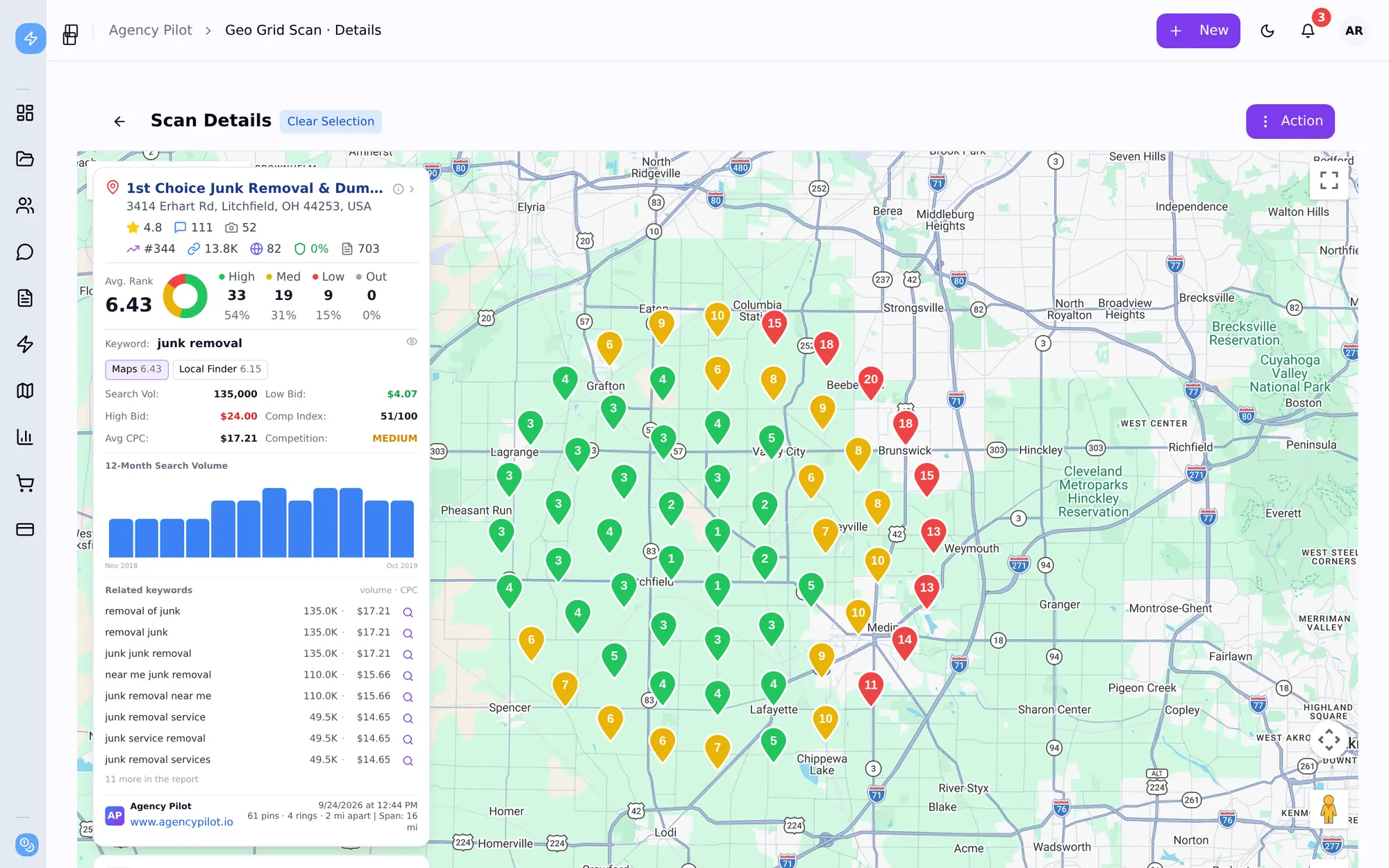
A profile audit says what's wrong; a geo grid says where it's costing the client. Run both and the Analyze step on the scan compares the profile with the five competitors that appear most often across the grid, including review velocity over 30 and 90 days.

A geo grid scan with the business profile panel showing rating, reviews and rank
The profile panel on a scan: rating, reviews, photos and rank across the grid.

What this does not do

Better to find this out here than three weeks in.

  • It audits Google Business Profile only — not Apple Business Connect, Bing Places or Yelp.
  • It reports what's wrong; it doesn't edit the profile. Make changes in Google (with the Manager access an onboarding link gets you).
  • It doesn't monitor the profile for unwanted edits between audits.

Questions

What should a Google Business Profile audit include?
Primary and secondary categories, hours, photos, description, attributes, review count, rating, review velocity and reply rate — ideally compared with the businesses currently in the map pack.
Do I need access to the profile to audit it?
No. The audit uses public data, so it works on prospects too.
Can I run it on a list of businesses?
Yes. Upload a CSV of up to 100 and run the audit on all of them.

Put your agency on autopilot

Start a 14-day trial with 300 credits. Add your first client and send an onboarding link today.

Give a Google Business Profile audit a clear scope

A Google Business Profile audit should start with the exact location and business the agency intends to assess. Confirm the public name, address or service-area context, website and profile identity before reading the grade. Businesses with multiple locations can have similar names and different local competitors. A report about the wrong branch can look convincing while producing recommendations that do not apply to the client you are helping.

Agency Pilot reviews public profile information and compares the business with leading map-pack competitors. Use that comparison to identify questions about completeness and presentation, then validate the details with the business owner. An audit can show what is publicly visible; it cannot independently confirm every operational fact. Hours, services and business attributes should reflect what the client actually offers, including exceptions that the owner needs to explain.

Review categories against the services the business delivers

Categories help describe the nature of the business, so review them alongside the actual services and the way the client positions itself. A competitor's category can prompt a useful question, but copying it without checking relevance can misrepresent the business. Ask the owner which services are central, which are occasional and which are no longer offered. Keep the explanation in the working notes so a later teammate understands the rationale for any proposed change.

The audit compares public category information; making an edit remains a separate task in Google. Before changing anything, confirm that the agency has the right access and that the owner agrees the selection accurately represents the business. Tie the recommendation to a verified service rather than to a promise that one category choice will produce a certain ranking. That keeps the work grounded in accurate business information.

Treat hours and contact information as customer-facing facts

Hours, contact details and the linked website affect what a prospective customer does next. Review them as part of a real journey: can someone find the correct location, understand when the business is available and reach the intended contact or booking route? The client may know about seasonal hours, temporary changes or appointment-only arrangements that are not obvious from public data. Resolve those questions before recommending an edit.

When a mismatch is found, describe the exact field and the source used to verify the correct information. A practical task is easier to complete than a vague instruction to improve the profile. Keep the website in the review as well, since a correct profile can still send a customer to an outdated contact page. Consistent customer-facing information reduces confusion even when a ranking effect cannot be isolated or promised.

Use photos, descriptions and attributes to explain the offer

A profile should help a customer recognize the business and understand whether it fits their need. Review photos for relevance and currency, and read the description for clear, accurate service information. Ask whether the visual material represents the actual location, team or work, and whether the written information is understandable to someone unfamiliar with the company. Avoid treating the audit as a reason to add large amounts of repetitive promotional copy.

Attributes should be checked against what the business can genuinely provide. If an item is uncertain, ask the owner instead of inferring it from a competitor. Keep approval and sourcing straightforward: the client supplies or confirms business facts, and the agency organizes the improvements. Agency Pilot's audit identifies areas to inspect, while the quality of the final profile depends on the accuracy and usefulness of the information published through Google's management tools.

Interpret review comparisons with business context

Review count, rating, velocity and reply rate describe different aspects of a public review profile. A large review count does not tell you whether recent customers mention a recurring service problem. A high reply rate does not establish that responses are helpful. Read a relevant sample alongside the numbers and separate the measurement from your interpretation. The goal is to identify a workable response or service process, not merely to chase a competitor's totals.

Use the comparison to ask practical questions. Is someone responsible for reviewing new feedback? Does the owner need to confirm facts before the agency replies? Are there recurring issues that should be passed to the service team? A report can reveal a gap in attention, but addressing it requires an agreed workflow. Keep customer details out of public responses and use the business's approved channel for resolving individual concerns.

Turn the audit into approved edits and follow-up work

Group findings into verified corrections, content improvements and items requiring the owner's input. For each task, identify the field or issue, the proposed change and the person who can approve it. Agency Pilot's audit does not edit the profile. Arrange the appropriate access separately, and make authorized changes through the Business Profile management process. This distinction matters when a client assumes receiving a report means the work has already been applied.

After changes are made, check the public presentation and retain the dates in the client work record. A later audit can revisit the same questions with a clear baseline. If the result changes, describe the observed difference and the work completed without claiming the agency controls every factor behind local results. The value of the workflow is accurate information, organized follow-through and a transparent record the client can review.

Combine profile audits with ongoing review awareness

A periodic profile audit and review monitoring serve related purposes at different intervals. The audit offers a broader view of public information and comparison with competitors. Review monitoring helps the team notice new feedback on the selected schedule. Use both when the engagement includes profile maintenance and reputation work, while keeping their scope clear to the client.

Neither should be described as continuous protection against every unwanted profile change. Agency Pilot's profile audit does not monitor all edits between runs, and responding to reviews happens in the Business Profile. Define how often your team reviews the account and which issues need a direct client conversation. This creates a service that is easier to deliver consistently than an open-ended promise to notice and fix every change immediately.

Frequently asked questions

Which business details should I confirm before running the audit?

Confirm the correct public profile, branch, website and location context. Similar names or multiple branches can produce confusion before the actual analysis starts. Ask the owner to verify any uncertain identity details. Once the correct business is selected, keep that identity consistent in later reviews so the agency can compare observations without accidentally switching to another listing or location.

Can the audit verify that published hours are operationally correct?

It can review the public information, but the owner remains the source for actual operating arrangements. Ask about seasonal hours, appointments and exceptions before proposing changes. Then compare the confirmed facts with what customers see on the profile and website. A mismatch should become a specific correction task with an owner, rather than a generic recommendation to improve completeness.

Should I copy the categories used by a leading competitor?

Use the comparison as a research prompt, not as an instruction to copy. Confirm that any proposed category accurately describes the client's business and main services. Competitors may operate differently, and their visibility does not prove that one category caused their result. Explain the relevance of a change to the owner and obtain the appropriate approval before editing the profile.

How do I assess a profile description beyond its length?

Read it as a customer trying to understand the business. It should explain relevant services clearly and accurately, without unsupported claims or repeated keyword phrases. Ask whether someone new to the business can tell what it does and whether it serves their need. The audit can identify a description to review, while editorial judgment determines whether the information is genuinely useful.

What should I look for in the profile's photos?

Look for material that accurately represents the business, location or work and is useful to a prospective customer. Check with the client that the photos remain current and appropriate to publish. More images are not automatically better if they are irrelevant or misleading. Use the audit to prompt a practical content review and request suitable replacements through the client's normal approval process.

Does a higher review count mean the competitor has better service?

Not by itself. Review count is a public measure of accumulated feedback, not a complete assessment of service quality. Consider the rating, recent themes and context alongside the count. Avoid making broad judgments about either business from one number. A useful comparison identifies where the client may need a more consistent feedback or response process, with recommendations grounded in what can actually be observed.

How should I interpret review velocity?

Treat it as a measure of how reviews accumulate during the relevant observation period. Compare periods and businesses carefully, since their customer volume and circumstances can differ. A change can prompt a question about the feedback process, but it does not establish the cause on its own. Keep the dates and context visible so the client understands exactly what the comparison represents.

Why review reply rate if the average rating is already high?

Reply rate can reveal how consistently the business acknowledges public feedback. A strong rating does not tell you whether new questions or concerns are receiving attention. Review response quality as well as the numerical rate, and agree who approves replies. The practical aim is a dependable communication process, not a percentage achieved through repetitive responses that fail to address the customer's actual concern.

Can Agency Pilot apply the audit's profile recommendations automatically?

The audit reports findings; it does not edit the profile. Make authorized changes through Google's Business Profile management process after confirming the facts and obtaining appropriate access. Keep a record of what was changed and when. This gives the next review a useful baseline and prevents the client from assuming that a shared audit has already corrected the issues it describes.

Do I need profile access to investigate public information?

The audit uses public information, so you can assess a prospect or client profile without management access. Access is a separate requirement when you need to make authorized changes or reply from the business. Keep those stages clear in the engagement. A public audit can start the conversation, while onboarding establishes the permissions needed to perform the agreed work afterward.

How should I handle several locations for the same brand?

Review each location's public facts and local competitive context separately. Shared branding does not make hours, services or surrounding competitors identical. Keep the branch identity visible in reports and tasks, and identify the person who can confirm location-specific details. You can summarize common issues across the account while preserving the evidence needed to fix the right field on the right profile.

Does the audit watch for unwanted edits between reports?

No, the existing profile audit is a report you run or schedule, not a monitor for every profile edit between audits. Set an appropriate review process with the client if ongoing profile maintenance is part of the engagement. Explain the scope directly so the owner understands when the agency checks information and how they should report a suspected change that needs attention.

How do I decide which profile issue to address first?

Start with confirmed information that could misdirect a customer or prevent contact, then prioritize other improvements according to relevance and effort. Identify which tasks require owner input and which can be completed with existing approval. The grade provides a summary, but the work plan should explain the practical consequence of each issue and how the team will verify the correction.

Can a better audit grade guarantee better map rankings?

No. A grade summarizes measured areas of the profile; it does not control search results or competitors. Accurate information and a useful profile are worthwhile objectives, but describe any ranking change as an observation rather than a guaranteed outcome. Combine the audit with comparable map scans if you want to investigate visibility, and keep the two measurements clearly distinguished in the report.

What should I retain for the next profile review?

Keep the original audit, confirmed business facts, approved changes and completion dates with the client work. Note any unresolved question and who is responsible for answering it. At the next review, compare the same location and explain changes in context. This creates a practical history that another teammate can understand and helps the client see the connection between findings and completed work.