
Local SEO toolkit
Local SEO tools for research, tracking and investigation
Choose a measurement for the client question: a map scan for geographical visibility, keyword tracking for a recurring baseline, or an audit for a specific research gap. Review the credit cost before running the work.
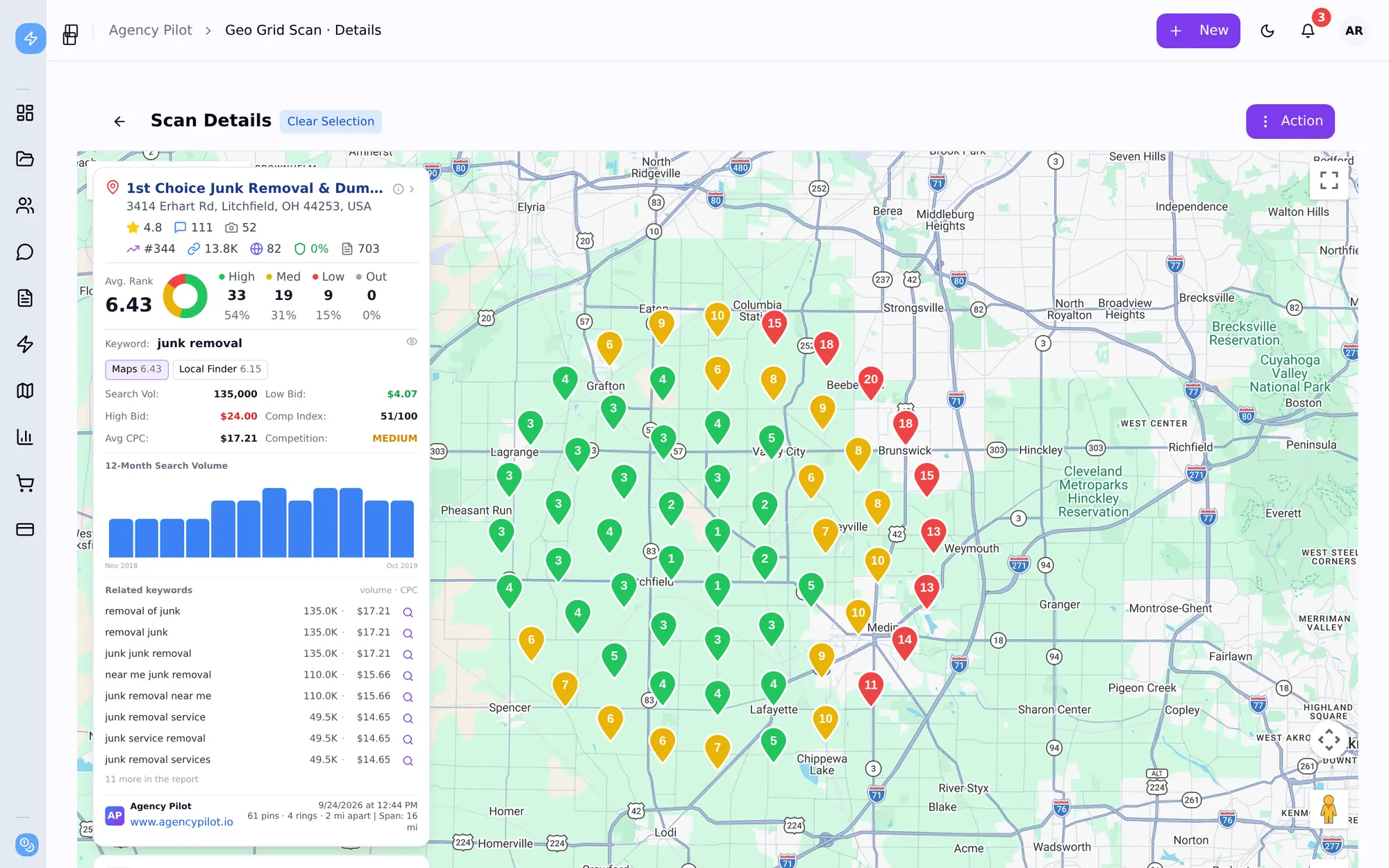
A ranking is a map, not a number
A roofer can sit in the top three downtown and nowhere at all four miles out. A geo grid makes that visible across sampled coordinates. It measures visibility for the chosen query and settings, not the number of customers or sales in each neighborhood.
Every scan is shareable as a live link, so you can send the result without exporting anything, and comparing two scans shows movement rather than asking the client to take your word for it.
The toolkit
Every local SEO tool, one credit balance
Choose the research surface that answers the question, then check its cost and output. Client-linked scans and tracking projects support ongoing delivery; keyword research keeps a separate, limited history.
Geo grid rank tracking
Rankings are not one number — they change street by street. A geo grid scan checks the same keyword from a grid of points across a service area and colours each one by position.
- Square grids up to 21 × 21 or circular grids up to 11 rings — up to 441 points
- Google Maps, Local Finder and organic results, to the top 100
- Competitor alerts, profile comparison and a verify link on every point
- Share a live link with the client — no login needed
- Compare two scans to show movement over time
Keyword rank tracking
Pick the terms that actually bring a client work and watch them over time, per location.
- Projects per client and location, weekly or monthly
- History that rolls into the monthly reports
- Priced per keyword per check, so a small list stays cheap
Keyword research
Volume, cost per click, difficulty and intent, plus whether AI assistants mention the topic — without paying for a second research seat.
- Search volume, CPC and difficulty
- Intent and AI mentions
- Keyword Gap and Market Opportunity audits for the bigger picture
Backlinks and link gaps
Audit a client's link profile, then find the sites linking to their competitors but not to them — a shortlist to investigate for relevance. A link gap does not establish that a placement is available or appropriate.
- Referring domains with quality signals
- Intersection across several competitors
- Export for outreach
Citation scans and the link directory
A citation scan finds where a business is listed and how its name, address and phone appear; a curated directory of citation sources saves rebuilding the same spreadsheet for every client.
- Name, phone and address searches plus the major directories
- Directory of vetted citation sources
- Bookmarks and notes on the sources you use
Ad research
See the Google ads a competitor has run before you write the first headline, so a new campaign starts from evidence.
- Google ads by domain, with format and dates shown
- Verified advertiser details
- 5 credits a lookup
From a question to evidence
A practical local SEO investigation
Keep the research decision separate from the report you later share. Here is a repeatable sequence for a client that wants to understand visibility in a specific service area.
1. Define the sample
Confirm the business, service query and area the client actually serves. Choose Maps, Local Finder or organic results deliberately. Keep the center, spacing, shape and depth with your notes so another scan can answer the same question.
2. Inspect the evidence
Review individual points and competing listings alongside the summary. Use an appropriate profile, website or keyword-gap audit to investigate a specific concern. A red pin does not diagnose a category problem, restriction or missing service page by itself.
3. Record the next check
Write down the observation, justified action and follow-up date in your work process. Keep measurement settings consistent when reviewing change. Use client reports to explain the outcome of the research; running a report is a separate step from choosing the investigation.
Illustrative research handoff
This is a fictional agency working note, not an actual customer result or an automatically generated product screen. It demonstrates what to retain after reviewing an observation.
- Question
- Does the selected service query show the correct business across the northern part of its confirmed service area?
- Evidence to retain
- Business identity, query, result surface, coordinates, scan settings and observation date. Record the actual result after running the scan.
- Interpretation
- If visibility is weaker at selected points, inspect the competing results and relevant public business information before proposing a cause.
- Next step
- Assign a specific investigation and a comparable follow-up. Do not translate sampled map coverage into a count of lost customers.
What the toolkit does not do for you
Research surfaces observations; it does not edit a Business Profile, publish website fixes or guarantee rankings. Keyword research history is retained for 30 days and is separate from client tracking projects. Save useful terms into the ongoing workflow. The Monthly Client SEO Report summarizes existing client evidence without fresh provider calls; choose a fresh scan or audit when the decision requires new measurements.
Run your first geo grid today
Choose a client question, review the scan settings and check the displayed credit cost before you run it.
Choose local SEO tools for agencies by the question
Different tools explain different parts of local visibility. A geo grid shows how observed positions vary across an area. Keyword tracking follows selected terms over time. An audit highlights issues or opportunities to investigate. Citation and backlink research add context about listings and links. Start with the question you need to answer, then choose the smallest useful set of research rather than running every available tool.
For example, a client who asks why they appear prominently near their office but not across town needs geographical context. A client whose website attracts visits without useful enquiries needs a broader review of search intent, pages, and lead handling. Both may involve local SEO, but the evidence and next action are different.
Choose fresh research or an existing-data roll-up
Start with the age and scope of the evidence you already have. A saved scan can answer what was observed at that time, but it does not establish the result today. The Monthly Client SEO Report rolls up existing client scans, tracked keywords and audits without making fresh provider calls. Choose it when the task is to review available evidence. Choose a scan or audit when a decision needs new observations. This distinction helps the specialist avoid paying for repeated research without a question, while also avoiding a stale summary presented as a new measurement.
Keyword research is another distinct workflow. A lookup is saved with the agency and user, and its history has a 30-day expiry. It is not automatically a client tracking project. Keep the terms you decide to monitor in the appropriate ongoing workflow and retain the reason for selecting them. When sharing findings with the account manager, name the source, observation date and question answered. This creates a useful handoff between the specialist choosing the research and the person preparing the client review, without assuming that every tool stores or refreshes data in the same way.
Investigate a weak area without overclaiming its cause
Suppose a scan shows stronger visibility near the business and weaker positions toward the edge of the service area. Confirm that the grid covers places where the client actually wants work. Check the query, search type, centre, spacing, and depth before comparing with an earlier scan. A changed configuration may explain part of the visual difference. Then review relevant profile and website evidence, rather than treating a red pin as a diagnosis by itself.
Choose an action whose rationale you can explain. The agency might investigate the relevance of a service page, review business information, or compare the local competitive context. The appropriate work depends on the evidence, and a map alone does not identify one guaranteed fix. Record the observation, proposed work, and next review date. At the following review, separate what was completed from what changed in the measurement. Include lead context where it is available, but avoid assuming correlation proves causation. This approach gives the client a clear account of the agency’s reasoning and helps the specialist learn from repeated observations without making promises the research cannot support.
Read keyword-gap output as a shortlist for investigation
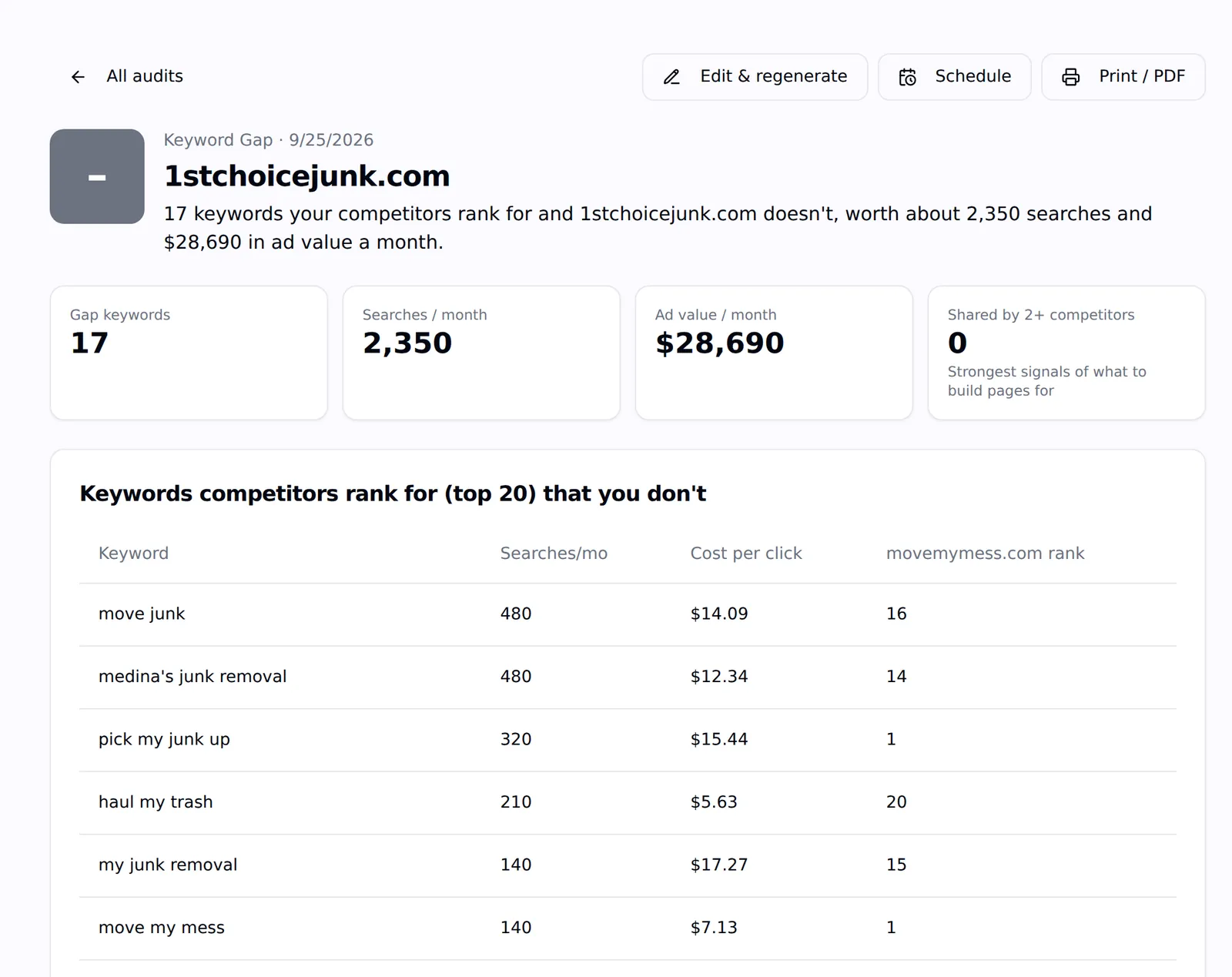
A Keyword Gap report can show terms competitors appear for alongside demand and cost-per-click context. The screenshot on this page uses sample-agency data to demonstrate the presentation. It does not establish the opportunity for your client. Review each candidate against the actual services, market and website before deciding whether a content task is warranted. A term may be irrelevant, belong to a different intent or already have an appropriate page that needs clarification rather than a new page.
For a useful working note, retain the candidate term, the business question it represents, the existing destination page if any, and the evidence still needed before action. Ask the client to confirm unfamiliar services rather than inferring that a competitor offer is something they can deliver. Volume and advertising cost are contextual estimates, not a count of customers you will acquire or revenue the work will generate. The output supports selection and prioritization; the agency must still verify the recommendation, secure the needed facts and approve the work through its delivery process.
Budget research around locations, queries and cadence
For each client, list the locations and service queries that genuinely need monitoring. Choose a grid setup that matches the area under review and record the intended scan cadence. Add the audits or reports required for the service, with their current credit costs. Keep an initial discovery allowance separate, because testing a useful configuration can involve work you should not automatically repeat every month. A clear model helps the specialist know which research is part of routine delivery and which requires a new reason.
Review the budget when the client adds a location, changes service focus, or requests more frequent investigation. Avoid solving every uncertainty by increasing scan detail or running every audit. First ask what decision the extra research would support. If the answer is clear, record the purpose and inspect the displayed cost before proceeding. Compare actual usage with the service plan after a reporting cycle. This gives the agency evidence for adjusting either the workflow or the package scope. It also helps explain why two clients with the same retainer may have different research needs without turning a published credit example into a universal promise about local SEO delivery.
Keep the explanation attached to the research decision
For each meaningful research result, save a concise interpretation: the client question, measurement settings, observation, and proposed action. A scan without context may be difficult for the next specialist to interpret. A note that simply says 'rankings improved' leaves out the area, query, period, and business relevance. Focus on the detail another person would need to continue the work responsibly, including any limitation that could change the interpretation.
Return to that note during the next review. Check whether the action was completed and whether the comparison still uses compatible settings. If the result moved unexpectedly, identify the question for further investigation rather than rewriting the original reasoning as if the outcome had been certain. Keep client-facing language clear: what was observed, what work was done, and what is being considered next. Internal speculation should not become an unsupported public claim. This small evidence trail improves continuity when staff change and makes a monthly review more than a fresh tour of charts. It also helps the agency decide when another scan or audit is warranted and when the available evidence is sufficient to move forward.
Frequently asked questions
Which local SEO tool should I use for geographical visibility?
Use a geo grid when the question concerns how a business appears from different locations for the same query. Choose a relevant area and consistent settings. Interpret the pattern with the client’s service boundaries in mind; a strong position outside the area they serve may not be commercially useful.
How is keyword tracking different from a geo grid?
Keyword tracking follows selected search terms and locations over time. A geo grid emphasises variation across multiple points in an area. Choose based on the question and use both where their perspectives add value. Avoid comparing results from different search contexts as if they were identical measurements.
What should I do with an SEO audit result?
Review the finding, verify its relevance to the client, and prioritise an action. An audit output is a starting point for investigation rather than an instruction to change everything immediately. Explain the expected purpose of the work and how you will check it, especially when several findings compete for limited delivery time.
How can I choose a useful keyword set?
Start with the services the business wants to sell and the language prospective customers use. Consider location and intent, not just apparent popularity. Use research to inform the shortlist, then confirm it with the client’s commercial priorities. A small relevant set is easier to interpret than a large unfocused list.
Should every client use the same grid size?
No. The service area, density of useful coverage, and question being investigated can differ. Choose a setup that provides enough detail to support a decision, and check its credit cost. Once a monitoring configuration is agreed, keep it consistent so later comparisons reflect observed movement rather than a changed measurement.
How should I explain an average ranking?
Explain what the underlying observations represent and whether missing results affect the calculation. An average can hide strong and weak areas, so review the map as well as the summary. Tie the explanation to the business’s target geography instead of using one aggregate number as the complete description of local performance.
What can citation research help me review?
Citation research helps investigate where a business appears and how identifying details are represented. Review relevant findings for accuracy and practical importance. A listing’s presence alone does not prove it is valuable, and a research result should be checked before outreach or editing. Keep the work tied to the client’s actual business details.
How should I use backlink gap information?
Use it to identify sites worth investigating, not as an automatic instruction to pursue every link. Consider relevance, quality, and whether the opportunity makes sense for the client. Record the reason for prioritising a target. The research can narrow the investigation, while the agency remains responsible for an appropriate outreach approach.
Can I promise a top-three position after an audit?
No. An audit or scan does not establish a guaranteed future position. Explain what was observed, which work you recommend, and the conditions that remain outside your control. A credible service promise describes the work, review process, and communication, rather than converting a research finding into a ranking guarantee.
How often should I repeat local SEO research?
Choose a cadence that matches the service, expected change, and decision you need to make. Frequent checks are useful only if they inform action. Keep recurring monitoring separate from extra investigation triggered by a specific event. Review the credit budget and avoid changing settings unnecessarily between scheduled comparisons.
How can I connect local visibility to business outcomes?
Review lead and sale information alongside search observations where those records are available and understood. Keep the definitions and periods clear. Visibility changes and revenue changes do not automatically prove a direct cause. Discuss the broader context, including website conversion and client follow-up, before attributing every outcome to rankings.
What belongs in a local SEO client review?
Show the relevant measurement, explain completed work, identify meaningful changes, and propose the next action. Include limitations or incomplete data that affect interpretation. Ask for the client’s operational context, such as a service change or missed calls. The review should produce a decision rather than merely walk through a collection of charts.
How should I compare several business locations?
Keep each location’s identity, service area, and reporting scope clear. Use comparable settings where a comparison is appropriate, but acknowledge differences in geography and market conditions. Avoid treating a stronger location as a universal benchmark without context. Record the question each location’s research is intended to answer.
How do credits fit into a local SEO retainer?
Estimate the recurring scans, audits, and reports included in the service, then add a reasonable allowance for investigation. Use current action costs and plan information. Keep initial discovery separate from ongoing monitoring. This helps you explain the delivery scope and understand the research cost within the retainer.
Where should a new specialist begin?
Start with the geo grid explanation, the relevant feature pages, and a representative client task. Ask the specialist to justify the settings and explain the result in plain language. Review their reasoning before expanding the workload. Learning how to interpret the evidence is as important as learning where to click.